
|
U. S. CIVIL WAR
PHOTOGRAPHS
|
|
SHARPSBURG (ANTIETAM)
(PAGE 6 OF 13)
| |
THE BATTLE
(Continued)
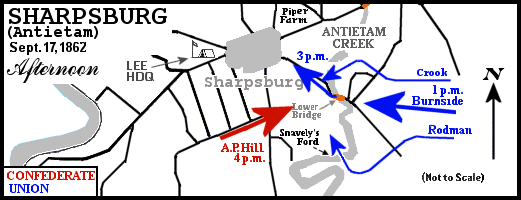
Afternoon Action.
In the morning, Confederates observed four divisions of Burnside's IX Corps
moving southward. Burnside's Corps was concentrating for an attack on the lower
bridge.
Protecting the bridge, in rifle pits overlooking it, were a few hundred Georgia
men under Brig. Gen. Robert Toombs.
 Beginning at 9 a.m. and continuing throughout the morning Burnside's men
attempted to cross the bridge but were beaten back by Confederate fire.
Burnside was apparently unaware that there were fords nearby which his men
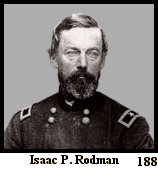
could have walked across. Eventually, Brig. Gen. Isaac Rodman's Union division,
moving south, found Snavely's Ford and were able to cross the Antietam and attack
the Confederate right flank.
At the same time, Colonel George Crook's scouts
located a ford several hundred yards north of the bridge and he sent a brigade
across. Around 1 p.m. with attacks on both Confederate flanks, Burnside was able
to send a column across the bridge and gain the other side.
Beginning at 9 a.m. and continuing throughout the morning Burnside's men
attempted to cross the bridge but were beaten back by Confederate fire.
Burnside was apparently unaware that there were fords nearby which his men
could have walked across. Eventually, Brig. Gen. Isaac Rodman's Union division,
moving south, found Snavely's Ford and were able to cross the Antietam and attack
the Confederate right flank.
At the same time, Colonel George Crook's scouts
located a ford several hundred yards north of the bridge and he sent a brigade
across. Around 1 p.m. with attacks on both Confederate flanks, Burnside was able
to send a column across the bridge and gain the other side.
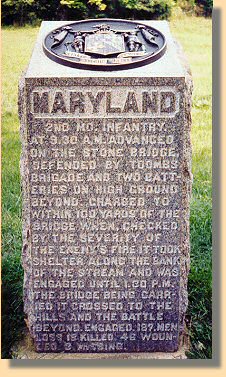
|
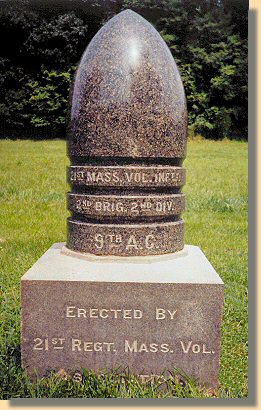
|
Maryland's 2nd Infantry
(Union) Monument
at Burnside's Bridge
To read the text click
HERE
|
21st Massachusetts Volunteer
Infantry (Union) Monument
at Burnside's Bridge
To read the text click
HERE
|
But it took two fateful hours for Burnside to reorganize his forces after taking
the bridge. At approximately 3 p.m. the mighty Union Corps finally began moving
toward Sharpsburg. Pushing back the small Confederate force facing them,
Burnside's men encountered artillery that Lee had quickly moved from the North,
but it only caused a short delay. They were just outside of Sharpsburg
encountering little or no resistance.
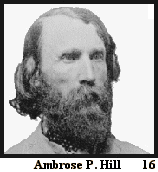 At this time, A.P. Hill's Division, which had been left at Harpers Ferry to
process the prisoners and who had received an urgent message from Lee to come to
Sharpsburg, arrived with five brigades on the Federal Flank. The resulting
confusion drove the Federals back to the lower bridge.
At this time, A.P. Hill's Division, which had been left at Harpers Ferry to
process the prisoners and who had received an urgent message from Lee to come to
Sharpsburg, arrived with five brigades on the Federal Flank. The resulting
confusion drove the Federals back to the lower bridge.
Although there were plenty of Union forces in reserve, McClellan discontinued the
attacks.
The next day (the 18th) the two exhausted armies stared at each other with no
significant action.
The Battle of Sharpsburg (or Antietam) is generally considered to be a draw, with
Lee's forces checking the much larger Union army. However, because of the
battle's impact on the Confederate Strategy of invading the North and because
Lee's forces eventually, on the night of the 18th, abandoned the battlefield,
the Union declared a victory.
On several occasions during the battle, McClellan's army could have destroyed
Lee's Southern forces, but McClellan, true to character, hesitated. The South had
been lucky having McClellan leading the Union army. Lee knew McClellan's
character and it is hard to say to what extent he relied on McClellan's character
in this battle. Lee was surprised by McClellan's initiative initially, but he
was not aware that McClellan had a copy of his special order 191. It must be
assumed that Lee kept the Confederate army on the battlefield all day on the 18th
because he believed McClellan would not attack and to show that he had not been
driven from the field. That night the Confederates moved out.
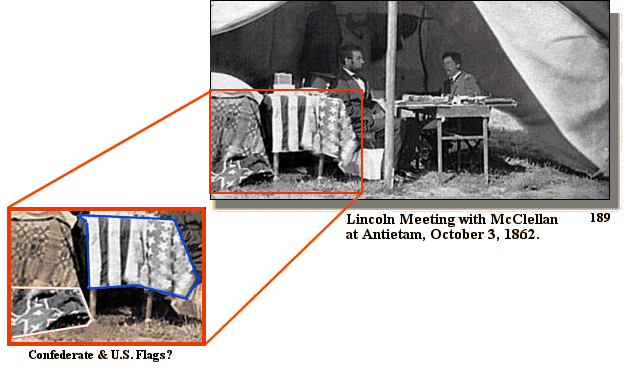
On October 1, 1862, President Lincoln arrived at Sharpsburg unexpectedly and spent
four days reviewing the troops, touring the battlefields, and visiting hospitals.
He also spent some time conferring with McClellan.
It was during this period that Lincoln, showing his frustration at McClellan's
caution in withholding units during the battle and reluctance to follow Lee
into Virginia, made his famous remark concerning McClellan. Stephen W. Sears
decscribed the comment in his book "Landscape Turned Red", published by
Ticknor & Fields:
Early one morning during his visit he and an acquaintance from Illinois, Ozias
M. Hatch, walked up to some high ground that overlooked the encampment of a
large part of the army. As they gazed at the vast sea of tents spread out
below, Lincoln suddenly asked, "Do you know what this is?"
"It is the Army of the Potomac," Hatch replied in some puzzlement.
"So it is called," Lincoln said, "but that is a mistake; it is only McClellan's
bodyguard."
|
|
|
PAGE SEVEN
 >
Civil War Photos
>
Sharpsburg
>
Page 2
>
3
>
4
>
5
>
6
>
7
>
8
>
9
>
10
>
11
>
12
>
13
>
Civil War Photos
>
Sharpsburg
>
Page 2
>
3
>
4
>
5
>
6
>
7
>
8
>
9
>
10
>
11
>
12
>
13
Notes
|
|