WHO BURNED
RICHMOND?
 266 266
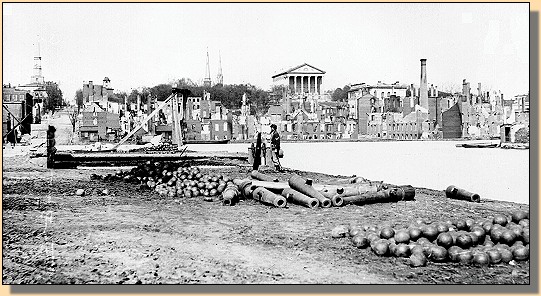
Ruins in front of the State Capitol, 1865.
(Richmond, Virginia)
Writers and interpreters of history, using basically the same source data,
sometimes come up with different conclusions concerning the same event. The
differences vary in importance, from minor, such as a soldier's opinion of an
event, to major, such as how many Union soldiers were killed in what period
of time at Cold Harbor or, as in this case, which actions resulted in the
business district of Richmond burning during the evacuation fire in April
1865.
The following illustrate this point
(Highlighting provided by the Editor.)
:
-
Nelson Lankford, author of Richmond Burning published by
Penguin Books, says, on page 107 of the paperback version of his
book,
"...Ewell (Confederate General.-Ed.) later laid responsibility
for the worst of the fires at the feet of the mob. He
swore
that they set fire to a large mill far from the tobacco warehouses fired
by his soldiers, and he further
alleged
that it was that burning mill, not the warehouses, that spread the
destruction. Certainly, in the predawn confusion,
some
of the looters
may
have set
some
fires. But Ewell convinced few people that the great fire had nothing to
do with his men or their deliberate demolition of the warehouses and
bridges through military orders passed down the chain of command...."
Perhaps the above statement is why Jonathan Yardley, of the The
Washington Post, says on the back cover of the paperback version,
"Unlike many of his predecessors, Lankford is able to see
without Lost Cause blinders or magnolia-suffused sentimentality."

Well let's see if we can continue
without Lost Cause blinders or magnolia-suffused sentimentality."
-
The National Archives, at
http:/www.archives.gov/research/civil-war/photos/,
says,
"...118. Silhouette of ruins of Haxall's mills, 1865, showing some of the
destruction
caused by a Confederate attempt to burn Richmond.
111-B-137...."
-
The Library of Congress, at http:/memory.loc.gov/ammem/today/apr02.shtml,
reports,
"...Richmond, meanwhile, burned, as fires set by fleeing Confederates
and looters"
raged out of control..."
-
The National Park Service, at
http:/www.nps.gov/history/history/online_books/hh/33/hh33s.htm, addresses
the burning of Richmond,
"...All semblance of law and order disappeared. When the guards at the
State penitentiary fled, the prisoners broke loose to roam the city at
will....The order had been given to burn all tobacco and cotton that could
not be removed by tossing flaming balls of tar into the warehouses along
the riverfront.
"...Mayor Mayo and the city council had appointed a committee in each ward
to see that all liquor was destroyed, and shortly after midnight they set
to work. Casks and barrels of the finest southern bourbons were rolled to
the curbs, the tops smashed open and left to drain.
"...The mobs swarmed and fought their way into the streets where the whiskey
flowed like water. Men...used...anything that would hold the...liquid. They
used rags on sticks dipped in whiskey for torches, and went howling through
the city in search of food and plunder like a pack of mad wolves, looting,
killing,
burning."
"...The blaze from the Shockhoe Warehouse at Thirteenth and Cary streets,
where 10,000 hogsheads of tobacco was put to the torch, flew skyward...The
flames quickly spread to the Franklin Paper Mills and the Gallego Flour
Mills.
"...A faint hot breeze began to stir from the southeast, scattering burning
embers through the streets and alleys and houses. Powder magazines and
arsenals let go with a whooshing boom. Thousands of bullets and shells tore
through buildings and ploughed up the streets.
"...Richmond was now one vast inferno of flame, noise, smoke, and trembling
earth. The roaring fire swept northwestward from the riverfront, hungrily
devouring the two railroad depots, all the banks, flour and paper mills, and
hotels, warehouses, stores, and houses by the hundreds.
"About dawn a large crowd gathered in front of the huge government
commissary at Fourteenth and Cary streets, on the eastern edge of the fire.
The doors were thrown open and the government clerks began an orderly
distribution of the supplies. Then the drunken mob joined the crowd.
"Barrels of hams, bacon, flour, molasses, sugar, coffee, and tea were rolled
into the streets or thrown from windows...When the building finally caught
fire from the whiskey torches, the mob swarmed into other sections of the
doomed city where the few remaining clothing, jewelry, and furniture stores
were ruthlessly looted and
burned."
A casket factory was broken into, the caskets
loaded with plunder and carried through the streets, and the fiendish rabble
roared on unchecked.
"As the drunken night reeled into morning the few remaining regiments of
General Kershaw's brigade, which had been guarding the lines east of
Richmond, galloped into the city on their way south to join Lee in his
retreat to Appomattox. They had to fight their way through the howling mob
to reach Mayo's Bridge. As the rearguard clattered over, Gen. M. W. Gary
shouted, "All over, good-bye; blow her to hell."
-
Charles B Dew, author of Ironmaker to the Confederacy published
by Library of Virginia, provides on Page 286 the following,
"...When the government began moving out of Richmond on the afternoon of
April 2, Anderson took added precautions to insure the safety of his plant
(Tredegar Iron Works -Ed.). Loyal members of the Tredegar Battalion
answered his call for aid, loaded their muskets, and took up positions
around the works. This action saved the Tredegar. Looting broke out as
Confederate troops tramped south across the James, and in the moonless early
morning hours of April 3 a rampaging mob seized control of the warehouse
district. Their ranks swollen by convicts who had broken loose en masse from
the nearby penitentiary,
looters spread the flames
originally put to government depots and tobacco storehouses.
Countermanding Gorgas' order not to destroy any ordnance facilities,
this motley crowd set fire to the Confederate arsenal,"
causing an explosion that shattered practically every window at the
Tredegar and sent shells crashing through the roofs of Anderson's buildings.
The arsonists then moved toward the nearby Tredegar plant to finish off
their night's handiwork. The resistance of Anderson and his men blunted
the thrust of the mob, however, and it broke and retreated back toward the
center of town."
In a footnote listing sources for the above, Dew says
"...Confederate troops did not attempt to burn Tredegar works, as several
of the above authors suggest"
So what is our opinion?
Obviously, the Confederates never intended to burn the city. We don't think
that even the Washington Post would take that position.
The mobs played a larger roll than current opinion wants to admit, in
spreading the fires.
As the fires spread, was their source the warehouse fires set by the
Confederates or the numerous other fires set by the mob? It appears more than
likely that both sources contributed to the destruction. But who knows which
fires were the source for which destruction?
And does it really matter now?
Yes it does. If we write or talk about the evacuation fires, we don't want to
be accused of having
"Lost Cause blinders and magnolia-suffused sentimentality,"
by a Washington Post employee.
Just our opinion,
Content Team
**
Bruce Catton addresses the "Lost Cause" in the book "Bruce Catton -
Reflections on the Civil War" edited by John Leekley, published by
Promontory Press.
On Pages 227-228 (hardback) Catton says, "The
essence of the legend of Lee and the dauntless Confederate soldiers was that
they suffered mightily in a great but lost cause. The point is that this very
phrase accepts the cause as having been lost. There was no hint in this legend
of biding one's time and waiting for a moment when there could be revenge.
This was the lost cause; something to be cherished, to be revered, to be the
outlet for emotions, but not to be the center of a new outbreak of violence.
In that sense, I think the legend of the lost cause has served the entire
country very well..."
Why the "Lost Cause" instills such dislike, approaching hatred, in the
Civil War elite, I have no idea. As an experiment, go on a History message
board and some where in your comments include the words "Lost Cause" (It does
not even have to be in context) and see what happens. Brace yourself, it will
not be pleasant. -Ed.
Return to Top
|
 >
Opinions
> Burning Richmond
>
Opinions
> Burning Richmond
Notes
|
|