
|
U. S. CIVIL WAR
PHOTOGRAPHS
|

|
ULYSSES S. GRANT
(Page Four of Four)
| |
Grant's success in maintaining the siege operations around Petersburg and
Richmond manifested itself in the collapse of Lee's lines on April 2, 1865
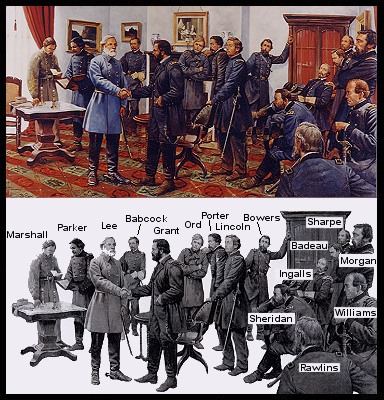
and the subsequent surrender at
Appomattox Court House, Virginia
on April 9, 1865.
At Appomattox...
|
|
 32
32
|
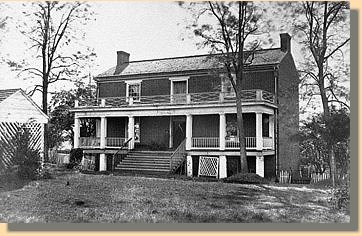
McLean House - 1865
|
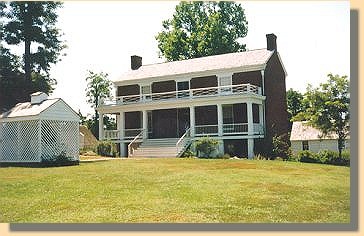
McLean House - 1998
|
[Where the surrender occurred. This is the same McLean
whose house was on the battlefield at
First Manassas.]
| |
 160 160
The Surrender at Appomattox, by Keith Rocco
[Source:
National Park
Service -Appomattox]
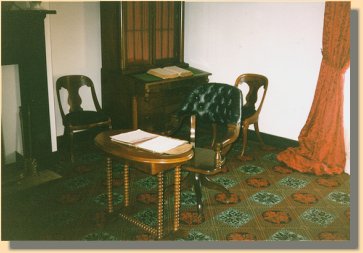
Grant's table (replica) at the McClean House at Appomattox
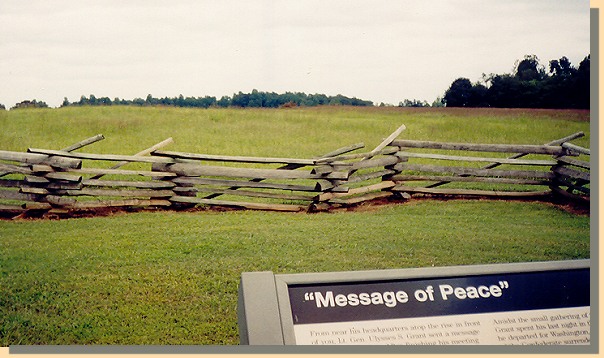
Where Grant wrote the message announcing the surrender.
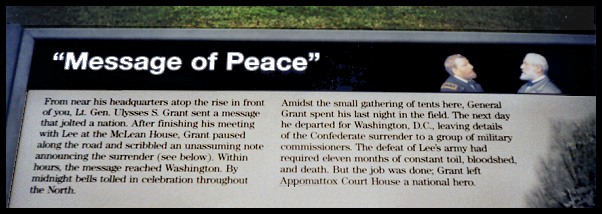
Interpretive Sign
|
|
From near his headquarters atop the rise in front
of you, Lt. Gen. Ulysses S. Grant sent a message
that jolted a nation. After finishing his meeting
with Lee at the McLean House, Grant paused
along the road and scribbled an unassuming note
announcing the surrender (see below). Within
hours, the message reached Washington. By
midnight bells tolled in celebration throughout
the North.
|
Amidst the small gathering of tents here, General
Grant spent his last night in the field. The next day
he departed for Washington, D.C., leaving details
of the Confederate surrender to a group of military
commissioners. The defeat of Lee's army had
required eleven months of constant toil, bloodshed,
and death. But the job was done; Grant left
Appomattox Court House a national hero.
|
Interpretive Sign Text
 231
231
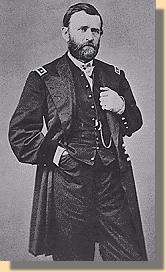
General Ulysses S. Grant (ca. 1860 - ca. 1865)
| |
Grant was elected President of the United States twice (1869-1877). In 1884
he lost all his savings in a financial venture and ended up writing his
autobiography to get his family out of poverty. He completed the book a
few days before his death of throat cancer in July of 1885. The book was a
success and his memoirs are considered one of the best ever written.
(Text sources include: NPS, US Army Center of Military History, and
www.senate.gov)
 257 257
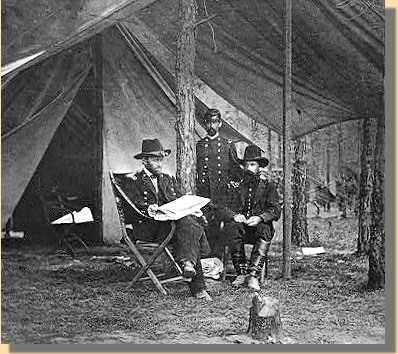
General Grant, Lt. Col. Bowers, and General Rawlins
at Grant's headquarters, Cold Harbor, June 11 or 12, 1864.
|
|
 >
Civil War Photos
>
Ulysses S. Grant
>
Page 2
>
3
>
4
>
Civil War Photos
>
Ulysses S. Grant
>
Page 2
>
3
>
4
Notes
|
|