
|
U. S. CIVIL WAR
PHOTOGRAPHS
|
|
JEFFERSON DAVIS
(Page Three of Three)
In the text, the icon  is a link to the definition of the word it marks.
Use your browser's "back"
button to return to this page.
| |
Davis resigned from the U.S. senate in January 1861 and was chosen President of
the Confederacy by the Provisional Congress and inaugurated in Montgomery,
Alabama, February 18, 1861.
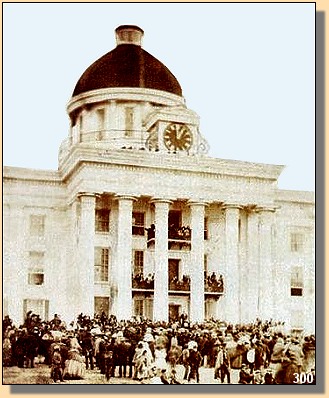
Jefferson Davis Inauguration
Montgomery, Alabama, February 18, 1861.
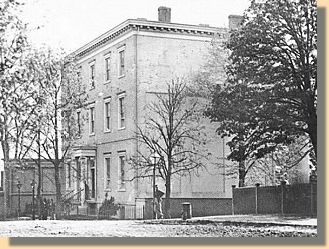
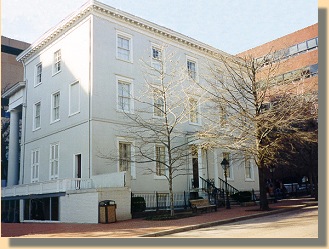
He was then elected President of the Confederacy for
a term of six years and inaugurated in Richmond, Virginia, February 22, 1862.
|
|
 57
57
|
|
Confederate White House - 1865
Richmond, Virginia.
|
Confederate White House - 1999
Richmond, Virginia.
|
| |
Davis' administration was marked by cronyism, autocracy, hard work, and complete
devotion to the cause. Outside his constant support of Lee, Davis often quarreled
with his generals and interfered with the War Department to the point where he
had six secretaries of war in four years . Still he worked ceaselessly, was able
to hold onto talented staff, and promoted a much needed nationalistic view of the
Confederacy.
In 1865, his responses to the failed Peace Conference and Gen. Lee's report on
the state of the army at Petersburg display Davis' complete dedication to the
Confederacy. Even with the surrender of Lee's and Johnston's armies he couldn't
accept the end of the Confederacy.
Jefferson Davis was captured by Union troops in Irwinsville, Georgia, on
May 10, 1865. He was accused of treason and of planning
the assassination of President Lincoln. Davis was taken to Fort Monroe, Virginia,
where he was treated harshly. Although he was accused of high crimes, he was
never brought to trial.
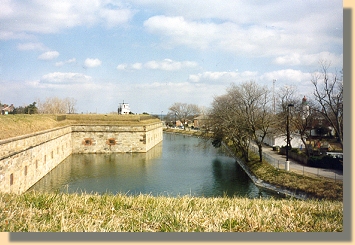
Fort Monroe - 1998
After two years in prison, in 1867 Jefferson Davis was paroled in the custody of
the court. Eventually he returned to Mississippi and spent the remaining years
of his life writing. He wrote "The Rise and and Fall of the Confederate
Government" in 1881.
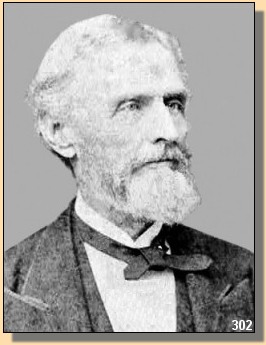
Jefferson Davis - 1888
When Davis was inaugurated president of the Confederate States of America in
1861, he believed in the right of Southern states to secede and defended his
belief until his death in 1889. While he spent his remaining years in Biloxi,
Mississippi, at the Beauvoir plantation, Davis never asked for, nor was he
granted, a pardon for his actions. However, in a speech at Mississippi City,
Mississippi, he said:
"The past is dead; let it bury its dead, its hopes and its aspirations.
Before you lies the future, a future full of golden promise, a future of
expanding national glory, before which all the world shall stand amazed."
Jefferson Davis died in New Orleans, Louisiana, on December 6, 1889 and was
buried in the Metairie Cemetery.
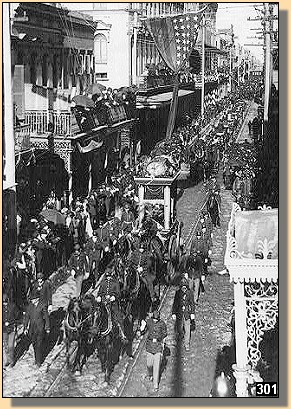
Jefferson Davis' Funeral in New Orleans, Louisiana.
In 1893 Jefferson Davis' body was moved to Richmond, Virginia, and on May 31,
he was buried in Hollywood Cemetery. (Go to the
Jefferson Davis Hollywood
Cemetery pages.)
Davis' labors on behalf of the Confederacy took a heavy personal toll. While
some historians have found much to criticize about his leadership, most
scholars consider that Davis guided the Confederacy as ably as one could expect,
given its situation.
Jefferson Davis was posthumously restored to the full rights of U.S.citizenship,
effective December 25, 1868, pursuant to a Joint Resolution of Congress
(Public Law 95-466), approved October 17, 1978.
(Source: Library of Congress, National Park Service and others.)
|
|
 >
Civil War Photos
>
Jefferson Davis
>
Page 2
>
3
>
Civil War Photos
>
Jefferson Davis
>
Page 2
>
3
Notes
|
|