
|
U. S. CIVIL WAR
PHOTOGRAPHS
|

|
COLD HARBOR
(PAGE 1 OF 3)
In the text, the icon  is a link to the definition of the word it marks. is a link to the definition of the word it marks.
Use your
browser's "back" button to return to the page.
Unless otherwise noted, the text source is the U.S. Gov't, National
Park Service.
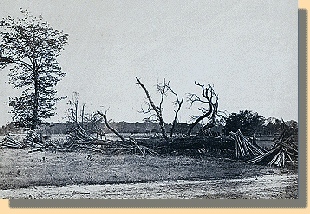 85
85
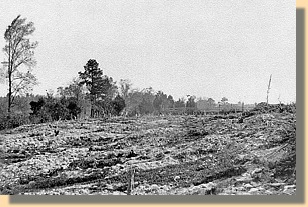
Cold Harbor Battlefield - 1865.
Extreme line of the Confederate works
|
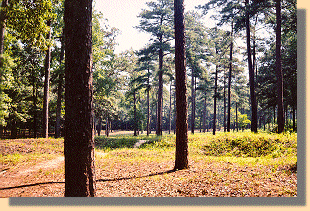
Cold Harbor Battlefield, Confederate View.
As it appeared in July, 2008.
|
| |
May 31-June 12, 1864
Estimated Casualties: 15,500 total
(US 13,000; CS 2,500)
On May 31, Sheridan's cavalry seized the vital crossroads of Old Cold Harbor.
Early on June 1, relying heavily on their new repeating carbines and shallow
entrenchments, Sheridan's troopers threw back an attack by Confederate infantry.
Afterward, Confederate reinforcements arrived from Richmond and from the Totopotomoy Creek
lines. Then, late on June 1, the Union VI and XVIII Corps reached Cold Harbor and assaulted the
Confederate works with some success.
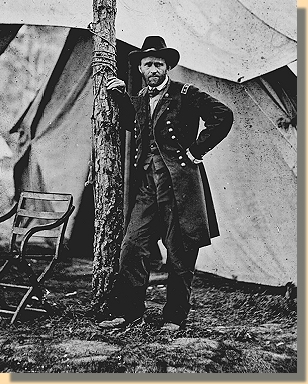 73 73
General U. S. Grant at Cold Harbor - 1864.
By June 2, both armies were on the field,
forming on a seven-mile front that extended from Bethesda Church to the
Chickahominy River. At dawn June 3, under orders from Grant, the II and XVIII
Corps, followed later by the IX Corps, assaulted along the whole front, even
though a considerable part of it had not been scouted by the Union
1.
|
|
THE RELATIONSHIP OF THE
1864 COLD HARBOR BATTLEFIELD (LEFT)
AND THE
1862 GAINES' MILL BATTLEFIELD (RIGHT)
(Troop positions are approximate.)
|
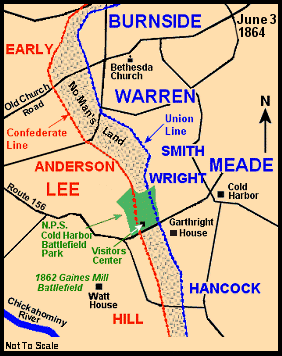
Cold Harbor - June 3, 1864
|
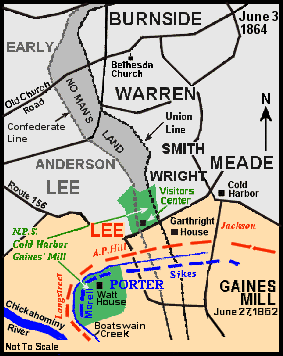
Gaines' Mill - June 27, 1862
On this map the Gaines' Mill
Battlefield (color) overlays the Cold Harbor Battlefield (grey scale).
|
|
| |
In the ensuing battle, which Grant called off around 30 minutes past noon
2,
there were thousands of Union casualties in a very short time span,
3
compared to less than 1,500 Confederate losses.
It was of this attack that Grant said,
"I have always regretted that the last assault at Cold Harbor was ever made. I
might say the same thing of the assault of the 22d of May, 1863, at Vicksburg.
At Cold Harbor no advantage whatever was gained to compensate for the heavy
loss we sustained. Indeed, the advantages other than those of relative losses,
were on the Confederate side."
4
The armies confronted each other on these
lines until the night of June 12, when Grant again advanced by his left flank, marching to James River. On June 14, the
II Corps was ferried across the river at Wilcox's Landing by transports. On June
15, the rest of the army began crossing on a 2,200-foot long pontoon bridge at Weyanoke. Abandoning the well-defended
approaches to Richmond, Grant sought to shift his army quickly south of the
river to threaten Petersburg.
- "Not War But Murder, Cold Harbor, 1864" by Ernest B. Furgurson.
- ibid.
- Current authors provide differing opinions on the number of casualties and
the duration in which they occurred. (See my
opinion.)
However, Grant did write that the losses were "heavy" (See above). Considering
the amount of losses that Grant sustained in other battles, "heavy" probably
means a substantial number. - Ed.
- "Personal Memoirs of U.S. Grant (Vol. 2)" by Ulysses S. Grant (Chapter LV).
|
|
 3
3
Cold Harbor Battlefield.
As it appeared in 1864 or 1865
|
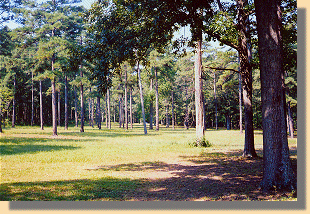
Cold Harbor Battlefield, Union view.
As it appeared in July, 2008.
|
PAGE TWO
 >
Civil War Photos
>
Richmond - Outlying
>
Cold Harbor
>
Page 2
>
3
>
Civil War Photos
>
Richmond - Outlying
>
Cold Harbor
>
Page 2
>
3
Notes
|
|