
|
U. S. CIVIL WAR
PHOTOGRAPHS
|
|
SHILOH
(PITTSBURG LANDING)
(PAGE 6 OF 8)
| |
 117 117
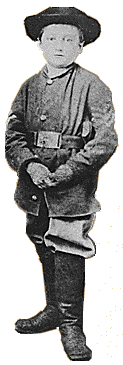
John Clem
1851 - 1937
Photograph taken in 1863,
when he was 12 years old.
|
The Drummer Boy of Shiloh
After the battle of Shiloh, a song and a play called "The Drummer Boy of Shiloh,"
were produced describing the participation of a ten year old Union drummer in
the battle. The play caused several people to come forward claiming that they
were the Drummer Boy of Shiloh.
A study by Ray H. Mattison, former historian at the Shiloh National Military
Park, proved that many of the claimants were ineligible for the designation.
Based upon Mattison's study, John Clem, also called "The Drummer Boy of
Chickamauga," has the strongest claim to the Shiloh title.
|
|
| |
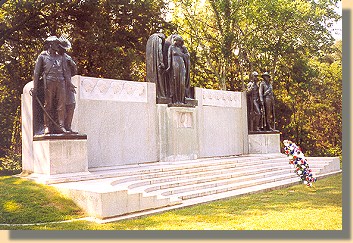
Confederate Monument
Placed by the U.D.C., May 17, 1917
The Shiloh CONFEDERATE MONUMENT combines symbolism with beauty to commemorate
the story of the Southern "Lost Cause" in the fields and woods near Shiloh
Church. Its prominent location marks a Confederate high water mark: Here, on
April 6, 1862, Confederates encircled and captured over 2,200 Federal troops,
including General Benjamin Prentiss, thus ending Union defense of the Hornets's
Nest.
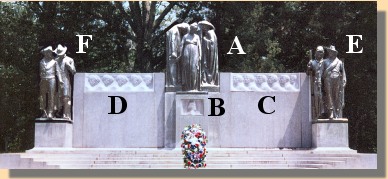
A -
Over eighteen feet high, the monument's central figures depict a "Defeated
Victory." In front, the South surrenders the laurel wreath of victory to Death
on her right, and night on her left. Death took away the commander-in-chief;
while Night, having brought on re-enforcements for the Federals stands waiting
to complete the defeat.
B -
Below them, in low relief, appears the figure of General Albert Sidney
Johnston, the southern commander. Johnston remains the highest ranking
American officer ever to die in combat.
C -
The panel of heads to the right represents the spirit of the first day's
battle. Exuberantly, hopefully, courageously, fearlessly, the young Confederates
rush into battle. The eleven soldiers portrayed equal the number of Confederate
states.
D -
The soldiers on the panel to the left, now fewer in number, represent the
second day's battle. Driven back over ground they had gained the day before,
Confederates are finally forced to retreat. The panel shows the sorrow of the
men who fought so hard for a victory so nearly won, and so unexpectedly lost.
The symbolically depicted "wave upon wave of soldiery" is now past its crest.
E -
At the far right, the infantryman has snatched up the Confederate flag in
defiance of the U. S. Army. In support by his side, the Artilleryman calmly
gazes through the smoke of battle.
F -
To the left, the Cavalryman spreads his hand in frustration. Although eager to
assist, the cavalry could not penetrate Shiloh's thick undergrowth. The rear
figure, head bowed in submission to the order to cease firing, represents the
Confederate officer corps. At that point, on the evening of the battle's first
day, Confederate victory had seemed imminent.
|
|
PAGE SEVEN
 >
Civil War Photos
>
Western Map
>
Shiloh
>
Page 2
>
3
>
4
>
5
>
6
>
7
>
8
>
Civil War Photos
>
Western Map
>
Shiloh
>
Page 2
>
3
>
4
>
5
>
6
>
7
>
8
Notes
|
|