|
U. S. CIVIL WAR
PHOTOGRAPHS
|
|
SECOND MANASSAS (BULL RUN)
PAGE THREE OF FIVE
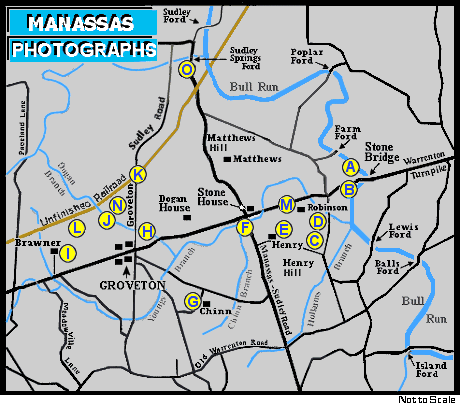
To see the location of a photograph in this section click on the circled letter,
 ,
at the photograph. ,
at the photograph.
| |
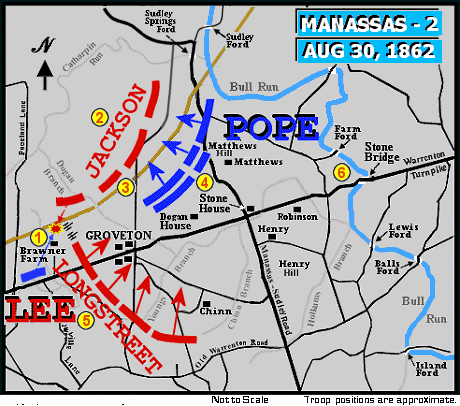
Second Manassas Battlefield Troop Movements.
In the text, the red numbers in parentheses
(3)
,
refer to the numbers
 on this map.
With his forces throwing rocks, Jackson ordered Brigadier General A.P. Hill to
send reinforcements. He also dispatched a request for help to Major General James
Longstreet.
Longstreet realized that his infantry would take too long to reach Jackson, but
he did have artillery that could bombard the flank of Porter's attacking forces.
The resulting fire from Longstreet's artillery not only stopped the Federals's
attack against Jackson's forces at the unfinished railroad, but it also
threatened any enemy forces sent in support.
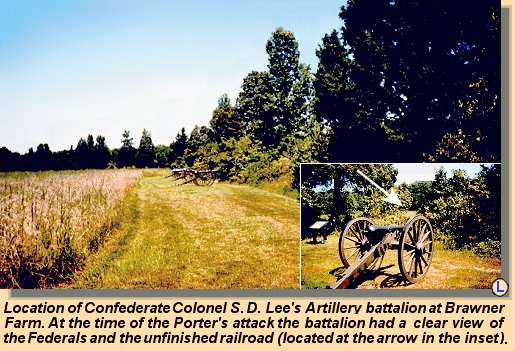
From the N.P.S. sign at the cannon shown above: "From here, Confederate
gunners had a clear view of Porter's attack --- the most formidable onslaught
of the three days. There were few trees between S. D. Lee's Battalion and the
nearest Union columns a third of a mile away. As thousands of bluecoats swept
across the field, Colonel Lee's men jumped to their guns and opened fire.
"The heavy bombardment, a rain of whizzing shell fragments, kept reinforcements
from crossing the field, and helped ensure Union defeat at Deep Cut."
With Porter's troops in disarray, Longstreet attacked the Union left flank
with over 28,000 men in the largest simultaneous mass assault of the war.
(5)
The Union flank was destroyed and Pope's army forced back to Bull Run.
(6)
Only a heroic stand by northern troops, first on Chinn Ridge and then once again
on Henry Hill, bought time for Pope's hard pressed Union forces. Under the cover
of darkness, the Union forces retreated back to the defense of Washington.
(Text Sources: Many and varied, including the U.S. Gov't, National Park
Service)
|
|
| |
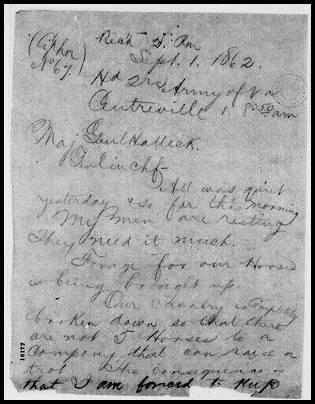
After-Battle Letter From Major General John Pope to
Major General Henry W. Halleck, General-in-chief
 167 167
The first page of an after-battle letter from US Maj. Gen.
John Pope to Maj. Gen. Henry W. Halleck, General-in-chief.
[Note 1 The following dispatch was sent following the Union defeat at Second Bull Run.]
(Cipher No 67.)
Rec'd 2. PM
Sept. 1. 1862.
Hd Qrs Army of Va
Centreville 1. 850 AM
All was quiet yesterday & so far this morning My men are resting They need it much.
Forage for our Horses is being brought up.
Our cavalry is completely broken down so that there are not 5 Horses to a company that can raise a trot. The consequence is that I am forced to keep considerable Infantry along the roads in my rear to make them secure & even then it is difficult to keep the enemy's Cavalry off the roads I shall attack again tomorrow if I can, the next day certainly.
I think it my duty to call your attention to the unsoldierly & dangerous conduct of many Brigade & some Division commanders of the forces sent here from the Peninsula. Every word & act & intention is discouraging & calculated to break down the spirits of the men & produce disaster
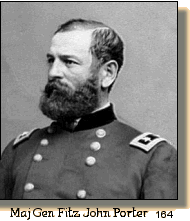
One commander of a Corps2 who was ordered to march from Manassas Junction to join me, when I reached the enemy near Groveton by way of Centreville although he was only five miles distant, failed to get up at all & worse still fell back to Manassas without a fight & in plain hearing at less than three miles distance, of a furious battle which raged all day. It was only in consequence of peremptory orders, that he joined me next day. One of his Brigades, the Brigadier General3 of which professed to be looking for his Division absolutely remained all day at Manassas -- in plain view of the Battle & made no attempt to join.
[Note 2 A reference to Fitz John Porter. For Pope's report on Second Bull Run, see Official Records, Series I, Volume 12, Part II, 12-20.]
[Note 3 A reference to General Charles Griffin. Though Griffin defended Fitz John Porter's conduct at Second Bull Run, his career was not harmed by his association with Porter. Griffin held a command in the 5th Corps until the end of the war.]
What renders the matter worse these are both officers of the Regular Army who do not hold back from ignorance or fear. Their constant talk indulged in publicly & in promiscuous company is that the "Army of the Potomac" will not fight, that they are demoralized by withdrawing from the peninsula. Etc, Etc,
Where such example is set by officers of high rank the influence is very bad amongst those in subordinate Stations. You have hardly an idea of the demoralization among officers of high rank in the Potomac Army arising in all instances from personal feeling in relation to change of Commander-in-Chief & others. These men are mere tools or parasites but their example is producing & must necessarily produce very disastrous results.
You should know these things, as you alone can stop it. Its source is beyond my reach though its effects are very perceptible & very dangerous. I am endeavoring to do all I can & will most assuredly put them where they shall fight or run away. My advice to you I give with freedom as I know you will not misunderstand. It is, that in view of any satisfactory results you draw back this army to the entrenchments in front of Washington & set to work in that secure place to re-organize & re-arrange it you may avoid great disaster by doing so. I do not consider the matter except in a purely military light & it is bad enough & grave enough to make some action very necessary
Where there is no heart in their leaders & every disposition to hang back much cannot be expected from men. Please hurry forward cavalry horses to me under strong escort I need them badly, worse than I can tell you.
John Pope4
[Note 4 Pope was removed from command the next day.]
Maj Genl
Comdg
John Pope to Henry W. Halleck, September 1, 1862 (Telegram concerning military affairs). Transcribed and annotated by the Lincoln Studies Center, Knox College, Galesburg, Illinois. Available at Abraham Lincoln Papers at the Library of Congress, Manuscript Division (Washington, D.C.: American Memory Project, [2000-02]), http:/memory.loc.gov/ammem/alhtml/alhome.shtml, accessed [March 20, 2003].
|
|
|
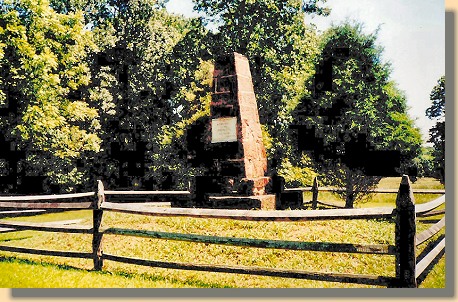
U.S.A. Monument at Groveton - 2003

Monument Plaque
In Memory of the Patriots who fell at Groveton
Aug 28th, 29th, and 30th, 1862
|
|
National Park Service Sign
|
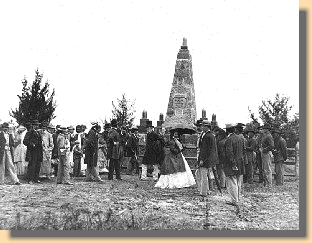
Second Bull Run Monument
Like its companion monument on
Henry Hill,
this obelisk was constructed by Union soldiers at the close of the Civil War.
It was dedicated during an elaborate ceremony held on June 10, 1865.
|
|
|
PAGE FOUR
 >
Civil War Photos
>
Manassas
>
Page 2
>
Second Manassas
>
Page 2
>
3
>
4
>
5
>
Civil War Photos
>
Manassas
>
Page 2
>
Second Manassas
>
Page 2
>
3
>
4
>
5
Notes
|
|

 ,
at the photograph.
,
at the photograph.